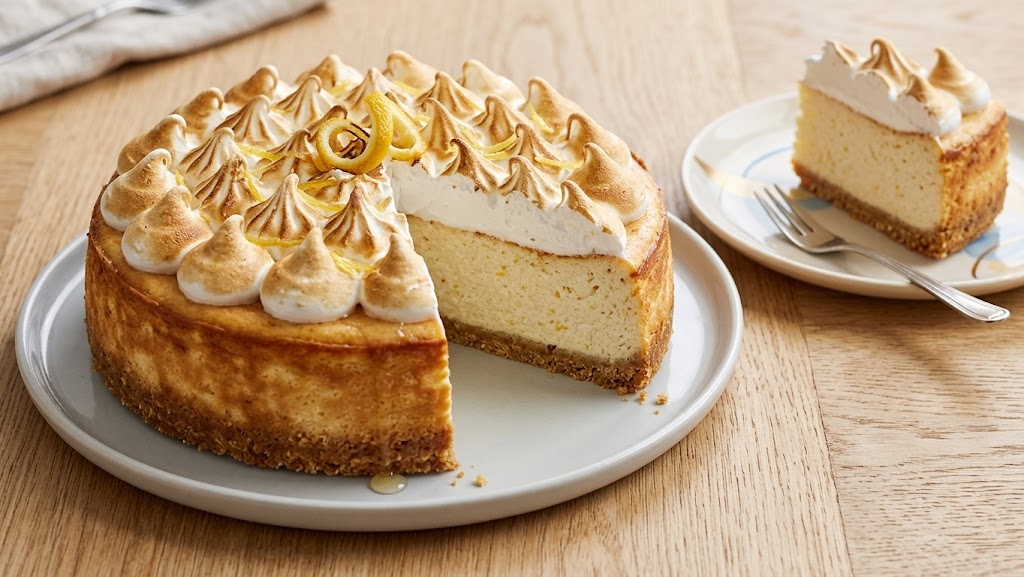
This lemon ricotta cheesecake is a bright, gently tangy baked cheesecake with a delicate, slightly fluffy crumb and a creamy finish. Ricotta keeps it lighter than a classic New York style bake, while fresh lemon zest and juice give it that clean, sunny flavour that makes you want a second slice. It’s straightforward for a confident beginner: no tricky techniques, just careful mixing and patient cooling. Total time is about 6 hours including chilling, with roughly 30 minutes of hands-on work.
Ingredients
For the Biscuit Base
- 250g digestive biscuits (or graham crackers), finely crushed
- 110g unsalted butter, melted
- 25g caster sugar
- Butter, for greasing
- Baking parchment, for lining
For the Lemon Ricotta Filling
- 500g full-fat ricotta
- 250g full-fat cream cheese, at room temperature
- 150g caster sugar
- 3 large eggs, at room temperature
- 2 tsp vanilla extract
- Finely grated zest of 2 lemons
- 60ml fresh lemon juice
- 2 tbsp cornflour (cornstarch)
- 150ml sour cream or crème fraîche
- Pinch of fine salt
To Finish (Optional)
- 4 to 6 tbsp lemon curd
- Icing sugar, for dusting
- Fresh raspberries or blueberries
How to Make Lemon Ricotta Cheesecake
Oven Preparation and Tin Setup
- Prepare the oven: Preheat the oven to 160°C or 140°C fan. Place a shelf in the middle so the cheesecake bakes evenly.
- Line the tin: Grease a 20cm springform tin, then line the base and sides with baking parchment. Make the paper come a little higher than the rim to protect the top edge.
Make the Biscuit Base
- Mix the base: Stir the crushed biscuits with the melted butter and caster sugar until the crumbs look evenly moistened.
- Press and chill: Tip into the tin and press firmly into an even layer (a flat-bottomed glass helps). Chill in the fridge for 10 minutes while you make the filling.
Mix the Filling (Smooth, Not Overbeaten)
- Beat the cheeses: In a large bowl, beat the ricotta, cream cheese, caster sugar, and a pinch of salt until smooth. Scrape down the sides so there are no hidden lumps.
- Add the eggs: Add the eggs one at a time, mixing on low speed just until each egg disappears into the batter. Overbeating adds air, which can lead to cracks.
- Add lemon and vanilla: Mix in the vanilla, lemon zest, and lemon juice.
- Thicken gently: Sift over the cornflour and fold it in. Fold in the sour cream until the batter looks silky and cohesive.
Bake Until Set With a Gentle Wobble
- Fill the tin: Pour the filling onto the chilled base and smooth the top with a spatula.
- Bake: Bake for 45 to 55 minutes. The outer ring should look set, but the centre should still have a soft wobble if you lightly nudge the tin.
Cool Slowly, Then Chill
- Cool in the oven: Turn the oven off, crack the door open, and leave the cheesecake inside for 45 to 60 minutes. This gradual cooling helps prevent sinking and cracking.
- Cool completely: Remove to a rack and cool to room temperature.
- Chill: Refrigerate for at least 4 hours, preferably overnight, so it slices cleanly.
Assemble and Serve
- Unmould neatly: Run a thin knife around the edge if needed, unclasp the tin, and peel away the parchment.
- Finish the top: Spread lemon curd over the chilled cheesecake for a glossy, extra-lemony finish, or keep it simple with icing sugar.
- Slice cleanly: Use a hot, dry knife and wipe between slices for bakery-style portions.

Tips
Why did my cheesecake crack on top?
Cracks usually come from too much air in the batter or a sudden temperature change. Mix on low once the eggs go in, and cool the cheesecake slowly in the switched-off oven with the door slightly open.
How do I avoid a soggy biscuit base?
Press the base very firmly and chill it before adding the filling. Also make sure your tin is properly lined so condensation does not soak into the crust as it chills.
How do I know when it’s baked without overcooking it?
Look for set edges and a gentle wobble in the centre. If the whole cheesecake ripples like liquid, it needs longer. If it looks puffed and completely firm, it may be heading towards dry.
What’s the best way to get a smooth filling with ricotta?
Use full-fat ricotta and bring it to room temperature. If your ricotta looks grainy, beat it briefly on its own first, then add the cream cheese and sugar.
Serving Suggestions
- Fresh raspberries and a light dusting of icing sugar
- A spoonful of lemon curd and a few blueberries
- Softly whipped cream with extra lemon zest
- Thin slices with hot tea or espresso
Storage
Room Temperature
Because this is a dairy-based dessert, keep it out at room temperature for no more than 2 hours total. Serve straight from the fridge for the neatest slices.
Refrigerator
Store covered in the fridge for up to 4 days. Keep it in the tin or in an airtight container to stop it picking up fridge odours.
Freezing
Freeze without fresh fruit on top for best results. Wrap individual slices tightly in cling film, then foil, and freeze for up to 2 months. Thaw overnight in the fridge, not on the counter, to keep the texture creamy.
Nutrition
- Calories: 380 kcal
- Carbohydrates: 28 g
- Protein: 10 g
- Fat: 24 g
- Saturated Fat: 14 g
- Sodium: 260 mg
Disclaimer: Nutrition values are estimates and will vary based on ingredients and portion size.
FAQs
Can I make this cheesecake without cream cheese?
Yes, you can make it with all ricotta, but the texture will be a little drier and more crumbly. If you go all-ricotta, add an extra 2–3 tablespoons sour cream and be careful not to overbake.
Do I need a water bath for this lemon ricotta cheesecake?
You don’t need one for a good result. A water bath can reduce cracking, but the simpler method here is gentle mixing and slow cooling in the turned-off oven, which works very well for home baking.
Why is my ricotta cheesecake grainy?
Ricotta can vary a lot by brand. Graininess usually comes from cold ricotta or a drier-style ricotta. Let it come to room temperature and beat it smooth before adding the other ingredients. Full-fat ricotta gives the creamiest texture.
Can I make it ahead for a dinner party?
Absolutely. Cheesecake is better made ahead. Bake the day before, chill overnight, and add lemon curd or berries shortly before serving for the freshest look.
How do I get clean slices without dragging the topping?
Chill the cheesecake thoroughly, then use a sharp knife warmed under hot water. Wipe the blade dry between cuts. If using lemon curd, spread it on just before serving so it stays glossy.
Can I use bottled lemon juice instead of fresh?
Fresh lemon juice tastes noticeably brighter here, especially since lemon is the main flavour. Bottled works in a pinch, but use fresh zest either way for the best aroma and flavour.
Lemon Ricotta Cheesecake
Course: DessertCuisine: BritishDifficulty: Easy12
slices30
minutes55
minutes360
minutes380
kcal1
hour25
minutesA light, zesty baked lemon ricotta cheesecake with a buttery biscuit base and a creamy lemon finish. Simple to make, easy to slice, and perfect for make-ahead entertaining.
Ingredients
Butter, for greasing the tin
Baking parchment (base and sides)
250g digestive biscuits (or graham crackers), finely crushed
110g unsalted butter, melted
25g caster sugar
500g full-fat ricotta
250g full-fat cream cheese (room temperature)
150g caster sugar
3 large eggs (room temperature)
2 tsp vanilla extract
2 lemons, zest finely grated
60ml fresh lemon juice (about 2 lemons)
2 tbsp cornflour (cornstarch)
150ml sour cream or crème fraîche
4–6 tbsp lemon curd (optional, to finish)
Icing sugar or fresh berries, to serve (optional)
Directions
- Preheat the oven to 160°C (140°C fan). Grease and line the base and sides of a 20cm springform tin.
- Mix crushed biscuits with melted butter and 25g sugar. Press firmly into the tin and chill for 10 minutes.
- Beat ricotta, cream cheese and 150g sugar until smooth. Scrape down the bowl.
- Beat in eggs one at a time, mixing on low just until combined. Stir in vanilla, lemon zest and lemon juice.
- Sift in cornflour, then fold in sour cream until the batter is silky.
- Pour filling onto the chilled base and smooth the top. Bake for 45–55 minutes until the edges are set and the centre still has a gentle wobble.
- Turn the oven off, crack the door open, and cool the cheesecake in the oven for 45–60 minutes to reduce cracking.
- Cool fully at room temperature, then refrigerate for at least 4 hours (overnight is best).
- Unmould, peel away parchment, and transfer to a serving plate. Spread lemon curd on top if using.
- Slice with a warm, clean knife and serve with berries or a light dusting of icing sugar.
Notes
- Room temperature dairy helps you get a smooth batter with minimal mixing.
- A slight wobble in the centre is ideal; it will set as it cools.
- For neat slices, warm your knife under hot water and wipe between cuts.